✨ New Arrivals Just Dropped!Explore
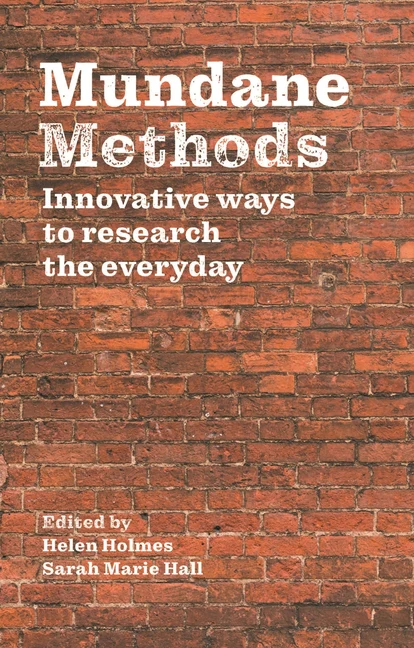
Mundane Methods: Innovative Ways to Research the Everyday (Volume I)
Mundane Methods is an innovative and original collection which will make a distinctive methodological and empirical contribution to research on the everyday. Bringing together a range of interdisciplinary approaches it provides a practical, hands-on approach for scholars interested in studying the mundane and exploring its potential. Divided into three key themes this volume explores methods for studying: materials and memories, emotions and senses, and mobilities and motion; with encounters, relationships, practices, spaces, temporalities and imaginaries cross-cutting throughout. In doing so, it draws on the work of a range of established and up-and-coming scholars researching the everyday, including human geographers, sociologists, anthropologists, urban planners, cartographers, and fashion historians. With empirical examples, practical tips, ethical considerations, and exercises.
$12.93
Original: $36.95
-65%Mundane Methods: Innovative Ways to Research the Everyday (Volume I)—
$36.95
$12.93Product Information
Product Information
Shipping & Returns
Shipping & Returns
Description
Mundane Methods is an innovative and original collection which will make a distinctive methodological and empirical contribution to research on the everyday. Bringing together a range of interdisciplinary approaches it provides a practical, hands-on approach for scholars interested in studying the mundane and exploring its potential. Divided into three key themes this volume explores methods for studying: materials and memories, emotions and senses, and mobilities and motion; with encounters, relationships, practices, spaces, temporalities and imaginaries cross-cutting throughout. In doing so, it draws on the work of a range of established and up-and-coming scholars researching the everyday, including human geographers, sociologists, anthropologists, urban planners, cartographers, and fashion historians. With empirical examples, practical tips, ethical considerations, and exercises.